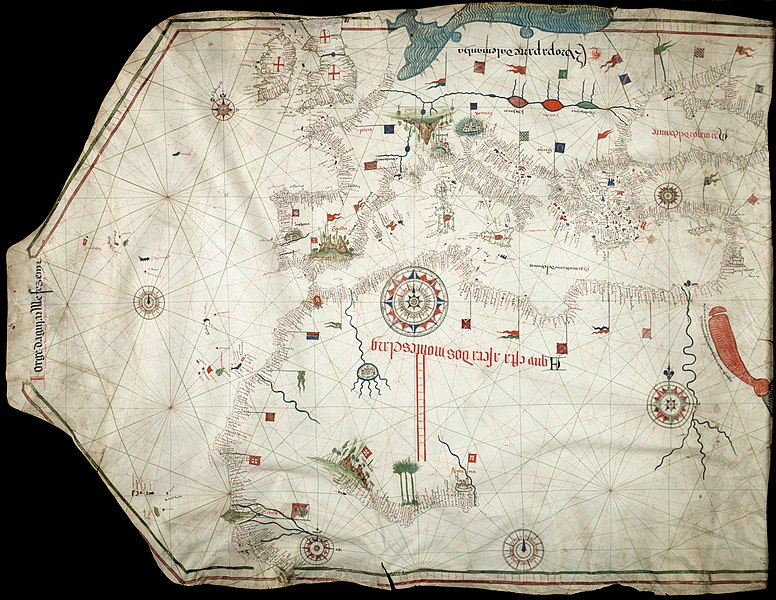
People in the Middle Ages greatly lacked geographical knowledge. While they were aware of the existence of distant places like China and sub-Saharan Africa, their knowledge was largely based on the scanty information found in ancient texts, which were notoriously inaccurate. What is more, medieval scholars saw a theological significance in the natural world in which everything was designed according to a harmonious model set in place by God. Thus geographical accuracy did not matter as much as symbolic importance. This is most evident in the so-called T and O maps that conceived of the world as divided into Asia, Africa, and Europe. The number three corresponded with the Trinity and was also backed by the Biblical story of Noah's three sons who scattered and repopulated the world after the Flood.
30 December 2011
Innovations in Medieval Mapmaking
People in the Middle Ages greatly lacked geographical knowledge. While they were aware of the existence of distant places like China and sub-Saharan Africa, their knowledge was largely based on the scanty information found in ancient texts, which were notoriously inaccurate. What is more, medieval scholars saw a theological significance in the natural world in which everything was designed according to a harmonious model set in place by God. Thus geographical accuracy did not matter as much as symbolic importance. This is most evident in the so-called T and O maps that conceived of the world as divided into Asia, Africa, and Europe. The number three corresponded with the Trinity and was also backed by the Biblical story of Noah's three sons who scattered and repopulated the world after the Flood.
28 December 2011
The Bayeaux Tapestry Online
The Bayeaux Tapestry is one of the iconic artifacts of the medieval era. Even people who aren't specifically familiar with it would have likely seen sections of it on book covers or in documentaries. It is 230 foot lone embroidered sheet of linen that depicts the events leading up to the Norman Conquest of England in 1066. It is best described as a type of comic strip or story board, with individual panels showing a particular event or episode. Before modern times it was kept at the Bayeaux Cathedral in Normandy (hence its name) and hung during local festivals. It was only in the 19th century when scholars from outside the region began to appreciate its historical value.
27 November 2011
Fall 2011 Final Exam
12 October 2011
30 September 2011
Fall 2011 Midterm
Directions: Answer TWO of the following questions in essay form using the same formatting requirements as your research papers. An adequate response will be at least 3 full typed pages. Your grade will be based on how well you incorporate evidence from the lectures, films, and reading assignments.
1) Much of the first portion of class focused on the growing divide between the eastern and western halves of the former Roman Empire. Discuss how this split occurred and its cultural consequences for the modern world. How did political events in the Islamic, Byzantine, and Germanic worlds contribute to this trend? How did the papacy and western rulers legitimize their independence from the emperor in Byzantium?
2) The Fossier text is a history of medieval attitudes towards nature, the human body, the stages of life and death, and the supernatural. Describe these attitudes and how they differ from our modern outlook.
3) Medieval society was extremely hierarchical and based on relationships of power. Discuss how power was articulated in medieval society. In what ways was it reciprocal? What were some of the limitations on power? What was the relationship between power and religion?